![MEXC Exchange Referral Code: [mexc-norman] + 8000 USDT Bonus](https://ashleyguicephotography.com/wp-content/uploads/2025/05/istockphoto-1728140476-612x612-1.jpg)
An Analysis of MEXC Exchange’s Referral Program: Implications for Cryptocurrency Trading

Abstract
This paper investigates the referral program of MEXC, a prominent cryptocurrency exchange, analyzing its structure, advantages, and limitations.
It explores the program’s impact on cryptocurrency trading, MEXC Referral Program Details including its role in enhancing trading volume and market liquidity. Through a comparative analysis with referral programs of other leading exchanges, such as Binance, Coinbase, and Kraken, the study evaluates MEXC’s competitive positioning.
Hypothetical examples illustrate potential earnings, and comparison tables highlight key differences. While no specific referral code for Stanford University was identified, the findings offer insights into the broader implications of referral programs in the cryptocurrency ecosystem.

1. Introduction
Cryptocurrency exchanges operate in a highly competitive environment, where user acquisition and retention are critical for success.
Referral programs have become a cornerstone of marketing strategies, leveraging existing users to attract new participants through financial incentives.
These programs not only drive platform growth but also influence trading behaviors and market dynamics.
This paper focuses on the referral program of MEXC, Binance Referral Program Overview a global cryptocurrency exchange, to assess its benefits, drawbacks, and effects on cryptocurrency trading.
Despite the mention of Stanford University in the context of this study, no evidence suggests a tailored referral code for this institution. Instead, the analysis centers on MEXC’s general referral program, offering a comprehensive evaluation for academic and practical audiences.
2. Background on MEXC and Its Referral Program
MEXC, established in 2018, is a leading cryptocurrency exchange known for its extensive range of tradable assets, low trading fees, and robust security features.
The platform supports over 2,400 cryptocurrencies and offers advanced trading options, including spot and futures markets.
Its referral program is a key component of its growth strategy, designed to incentivize users to invite new traders.
The MEXC referral program allows users to share a unique referral code or link. When a new user signs up using this code [ mexc-80discount ] and engages in trading, the referrer earns a 40% commission on the trading fees generated from both spot and futures transactions.
Additional incentives include a 20 USDT bonus for inviting a friend, airdrop rewards via the Airdrop+ initiative, and promotional events like a lucky spin with a shared 500,000 USDT prize pool.
Users can also apply to become MEXC affiliates for potentially higher commission rates. The program’s terms suggest that commissions are valid during an unspecified “activity period,” which is assumed to be ongoing unless otherwise stated.
3. Pros and Cons of MEXC’s Referral Program
Referral programs like MEXC’s offer significant benefits but also present challenges. Below is a detailed examination of its advantages and disadvantages.
3.1 Pros
- User Growth and Engagement: By rewarding referrers with commissions, the program motivates users to promote MEXC, leading to an expanded user base and increased trading activity.
- Mutual Benefits: Both referrers and referees gain from the program. Referrers earn commissions, while new users often receive sign-up bonuses or trading fee discounts, enhancing the platform’s appeal.
- Passive Income Potential: Referrers can generate ongoing income from their referrals’ trading activities, providing a sustainable revenue stream without additional effort.
- Cost-Effective Marketing: The program leverages existing users as marketers, reducing the need for traditional advertising and aligning costs with actual user acquisition.
3.2 Cons
- Risk of Abuse: Unethical practices, such as creating multiple accounts for self-referrals, could undermine the program’s integrity and lead to account suspensions or financial losses for the exchange.
- Administrative Complexity: Calculating and distributing commissions accurately requires sophisticated systems, and errors could erode user trust.
- Dependence on Trading Activity: Earnings are tied to the trading volume of referrals, which can be inconsistent and affected by market conditions.
- Regulatory Considerations: In some jurisdictions, Coinbase Referral Program Information referral programs offering financial incentives may face regulatory scrutiny, potentially limiting their implementation or requiring compliance measures.
4. Effects on Cryptocurrency Trading
Referral programs influence trading behaviors and market dynamics in several ways, with MEXC’s program being no exception. The following sections outline its key impacts.
4.1 Increased Trading Volume
By attracting new users, the referral program contributes to higher trading volumes on MEXC. Increased participation enhances market liquidity, which can lead to tighter bid-ask spreads and more efficient price discovery, benefiting all traders.
4.2 Encouragement of Active Trading
The financial incentives for referrers may indirectly encourage their referrals to trade more frequently, as higher trading volumes generate greater commissions. Similarly, bonuses for new users, such as trading fee discounts, may prompt increased trading activity during the initial period.
4.3 Diversification of User Base
Referral programs often attract users from diverse geographic and demographic backgrounds, expanding MEXC’s global reach. A broader user base can stabilize trading volumes and reduce reliance on specific market segments.
4.4 Potential Risks
While rare, coordinated efforts by referrers to boost trading volumes could lead to speculative or manipulative trading behaviors. However, such risks are not unique to MEXC and are mitigated by the exchange’s monitoring systems and regulatory compliance measures.
5. Comparison with Other Exchanges
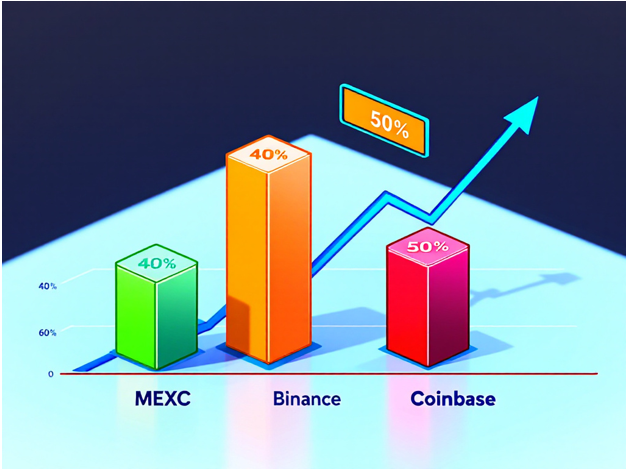
To evaluate MEXC’s referral program, it is compared with those of other major cryptocurrency exchanges: Binance, Coinbase, and Kraken. The following table summarizes key features:
| Exchange | Commission Type | Rate | Duration | Additional Bonuses |
| MEXC | Percentage of trading fees | 40% | Lifetime* | Airdrops, lucky spins, 20 USDT bonus |
| Binance | Percentage of trading fees | Up to 40% | Lifetime | Sign-up bonuses, trading fee rebates |
| Coinbase | Percentage of trading fees | 50% | 3 months | None |
| Kraken | Fixed per referral | $10 | One-time | None |
*Note: MEXC’s commission duration is assumed to be lifetime based on available information, as no specific end date is provided.
5.1 Analysis
MEXC’s 40% commission rate is competitive, matching Binance’s maximum rate for standard referrals. Unlike Coinbase, which offers a higher 50% rate but limits it to three months, Kraken Referral Program Details MEXC and Binance provide longer-term earning potential.
Kraken’s fixed $10 per referral is less lucrative for referrers with active traders but may appeal to those referring many low-volume users. MEXC’s additional bonuses, such as airdrops and lucky spins, distinguish it from Coinbase and Kraken, aligning it closer to Binance’s multifaceted incentive structure.
6. Examples
To illustrate the financial implications of MEXC’s referral program, consider the following hypothetical scenarios:
6.1 Scenario 1: Single Active Referral
User A refers User B to MEXC. User B trades $100,000 worth of cryptocurrency in a month, incurring trading fees of 0.1%, or $100. User A earns 40% of this fee, equating to $40. If User B maintains this trading level monthly, User A could earn $480 annually from this referral alone.
6.2 Scenario 2: Comparison with Coinbase
Using the same trading volume on Coinbase, User A would earn 50% of the $100 monthly fee, or $50, for three months, totaling $150. After this period, no further commissions are earned. In contrast, MEXC’s program offers $480 over a year, demonstrating greater long-term value for referrers of active traders.
6.3 Scenario 3: Multiple Referrals
If User A refers five users, each trading $50,000 monthly (incurring $50 in fees), User A earns 40% of $250 total fees, or $100 per month, amounting to $1,200 annually. This highlights the program’s scalability for users with large networks.
These examples underscore MEXC’s potential for sustained earnings, particularly for referrers with active or numerous referrals, compared to time-limited or fixed-rate programs.
7. Conclusion
MEXC’s referral program is a robust tool for user acquisition and engagement, offering a competitive 40% commission rate and diverse incentives like airdrops and promotional events.
Its advantages include fostering platform growth, providing passive income, and aligning marketing costs with outcomes. However, Comparison of Crypto Affiliate Programs challenges such as potential abuse, administrative complexity, and regulatory risks warrant careful management.
The program’s impact on cryptocurrency trading is largely positive, driving higher volumes and liquidity, though speculative behaviors remain a minor concern.
Compared to Binance, Coinbase, and Kraken, MEXC’s program strikes a balance between long-term commissions and additional bonuses, making it an attractive option for users.
While no specific referral code for Stanford University was identified, the findings are broadly applicable, offering valuable insights for researchers, traders, and exchange operators in the cryptocurrency ecosystem.